
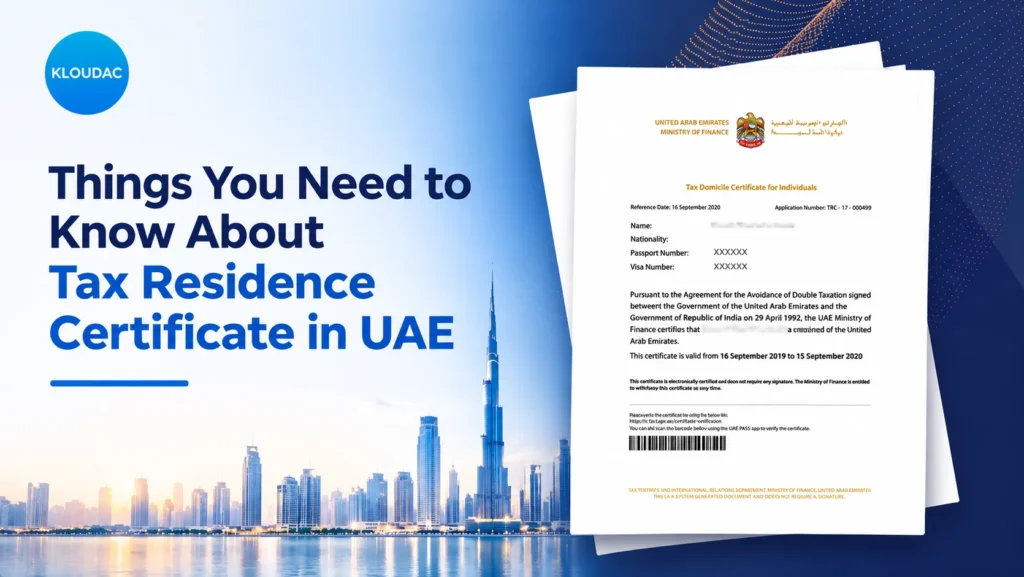
A Dubai-based consultant receives income from overseas, but the foreign tax authority asks for proof of UAE tax residency before considering treaty benefits. Although the consultant has a UAE residence visa, that alone may not satisfy the request.
This is where a Tax Residence Certificate in UAE becomes important. Issued by the Federal Tax Authority (FTA), the certificate helps individuals and businesses demonstrate their UAE tax residency for a specified period.
However, eligibility depends on several factors, including physical presence, business establishment and the purpose of the certificate.
What Is a UAE Tax Residence Certificate?
A UAE Tax Residence Certificate (TRC), also called a Tax Residency Certificate, is an official document confirming an individual’s or company’s UAE tax residency.
The FTA issues certificates for two main purposes:
- Double Taxation Agreement (DTA) purposes: To support claims under applicable tax treaties between the UAE and other countries.
- Other purposes: To provide evidence of UAE tax residency where a treaty-related certificate is not required.
A TRC does not automatically eliminate foreign taxes. Whether treaty benefits apply depends on the relevant agreement and the applicant’s circumstances.
Who Is Eligible for a Tax Residence Certificate in UAE?
Eligibility differs between individuals and companies. It is important to understand the applicable conditions before applying.
Tax Residency Requirements for Individuals
Under UAE domestic tax residency rules, an individual may qualify through one of three tests:
- The 183-day rule
The individual has been physically present in the UAE for at least 183 days during a consecutive 12-month period.
- The 90-day rule
The individual has spent at least 90 days in the UAE during a consecutive 12-month period, is a UAE or GCC national or holds a valid UAE residence permit, and meets additional conditions relating to permanent residence, employment or business.
- Primary residence and personal interests
The UAE is the individual’s usual or primary place of residence and centre of financial and personal interests.
These are domestic residency tests. Applicants requesting certificates for treaty purposes must also consider the relevant treaty provisions.
Eligibility for UAE Companies
A UAE company generally needs to demonstrate its qualifying tax residency and provide the required business documentation.
The FTA currently requires juridical-person applicants to have been incorporated or established for at least 12 months.
Eligible mainland and free zone companies may apply, subject to the relevant conditions.
However, the FTA’s current certificate service excludes offshore companies and branches of foreign companies.
Documents Required for a UAE Tax Residency Certificate
Documentation depends on whether the applicant is an individual or a company, the applicable residency test and the certificate’s intended purpose.
For Individuals
Depending on the circumstances, supporting documents may include:
- Passport and Emirates ID.
- Official UAE entry and exit report.
- Evidence of UAE employment, business activities or income.
- Proof of permanent or primary residence.
- Evidence of financial and personal interests in the UAE.
Additional evidence may be required for treaty-related applications.
For Companies
The FTA may require:
- Valid trade licence and lease agreement.
- Certificate of incorporation.
- Memorandum of Association.
- Corporate Tax Registration Number, if available.
- Authorised signatory’s identification and proof of authorisation.
- Evidence of effective management and control in the UAE, where applicable.
Applicants should review the latest FTA Tax Residency Certificate requirements before submitting documents.
How to Apply for a Tax Residence Certificate Through EmaraTax
The UAE Tax Residency Certificate application process is completed online.
- Access the FTA’s EmaraTax certificate service and sign in or create an account.
- Navigate to Other Services and select Tax Residency Certificate.
- Choose the applicable Corporate Tax Registration Number, or indicate that none is available.
- Select whether the certificate is required for DTA purposes or another purpose.
- Enter the requested details and select the relevant period.
- Upload supporting documents and request any additional certificate services, if needed.
- Pay the applicable fees and submit the application.
- Once approved, download the digital certificate.
The FTA may request additional information before completing its review.
UAE Tax Residency Certificate Fees and Processing Time
According to the FTA’s published service information, the current fees are:
| Applicant category | Fee |
| Application submission | AED 50 |
| Applicant with Corporate Tax TRN | AED 500 |
| Individual without Corporate Tax TRN | AED 1,000 |
| Company without Corporate Tax TRN | AED 1,750 |
| Optional printed certificate | AED 250 per copy |
The AED 50 submission fee is additional to the applicable certificate fee.
The FTA estimates 10 business days to process a complete application. Printed certificates and certain international forms may require additional time.
How Does a TRC Help Avoid Double Taxation?
Consider a UAE company receiving service payments from an overseas customer.
The customer’s country may impose withholding tax on certain payments. If an applicable double taxation agreement provides relief, the company may need to demonstrate its UAE tax residency.
A TRC can support that claim.
However, the foreign tax authority may also examine the company’s eligibility under the treaty, the nature of the income and other applicable conditions.
Businesses can check relevant agreements through the UAE Ministry of Finance’s International Treaties Dashboard.
Common Mistakes When Applying for a UAE TRC
Applications can face delays when supporting information is incomplete or inconsistent.
Common problems include selecting an incorrect certificate period, misunderstanding residency requirements, submitting incomplete identification documents or choosing the wrong certificate purpose.
Another mistake is assuming that a UAE residence visa automatically establishes tax residency.
Reviewing eligibility and documentation before submission can help avoid unnecessary delays.
Tax Residence Certificate Assistance from KLOUDAC
KLOUDAC provides accounting and taxation support for individuals and businesses operating in Dubai and across the UAE.
Applicants who need assistance understanding TRC requirements, preparing documentation or reviewing their application circumstances can seek professional guidance.
For assistance with your UAE Tax Residency Certificate application, contact KLOUDAC to discuss your requirements.
Frequently Asked Questions
1. How many days must I stay in the UAE to obtain a TRC?
Under domestic residency rules, individuals may qualify through the 183-day test, the conditional 90-day test or the primary residence and centre of interests test. Treaty requirements may differ.
2. Can a UAE free zone company apply for a Tax Residence Certificate?
Yes, an eligible UAE free zone company may apply if it meets the applicable FTA requirements, including the minimum establishment period.
3. Can I apply without a Corporate Tax Registration Number?
Yes, the FTA provides an application option for applicants without a Corporate Tax TRN. However, additional treaty-specific requirements may apply.
4. How long is a UAE Tax Residence Certificate valid?
A UAE Tax Residence Certificate covers a specified period of up to 12 months. Companies may generally apply once three months of the selected period have elapsed, provided they have been established for at least 12 months. Individuals may apply once they meet the applicable UAE tax residency requirements.
5. Does a UAE Tax Residence Certificate guarantee exemption from foreign taxes?
No. A TRC provides evidence of UAE tax residency, but eligibility for foreign tax relief depends on the applicable treaty and the relevant country’s requirements.
Conclusion
Obtaining a UAE Tax Residence Certificate requires more than holding a residence visa or operating a registered company.
Understanding the applicable residency tests, preparing accurate documents and selecting the correct certificate purpose are important steps.
For individuals and businesses with international income or cross-border activities, a properly obtained TRC can provide valuable evidence of UAE tax residency and support applicable treaty claims.