
For nearly three years, thousands of small and medium businesses across the UAE have operated under a comfortable safety net: Small Business Relief (SBR). This provision let qualifying SMEs elect zero taxable income and pay 0% corporate tax, even while turning a healthy profit.
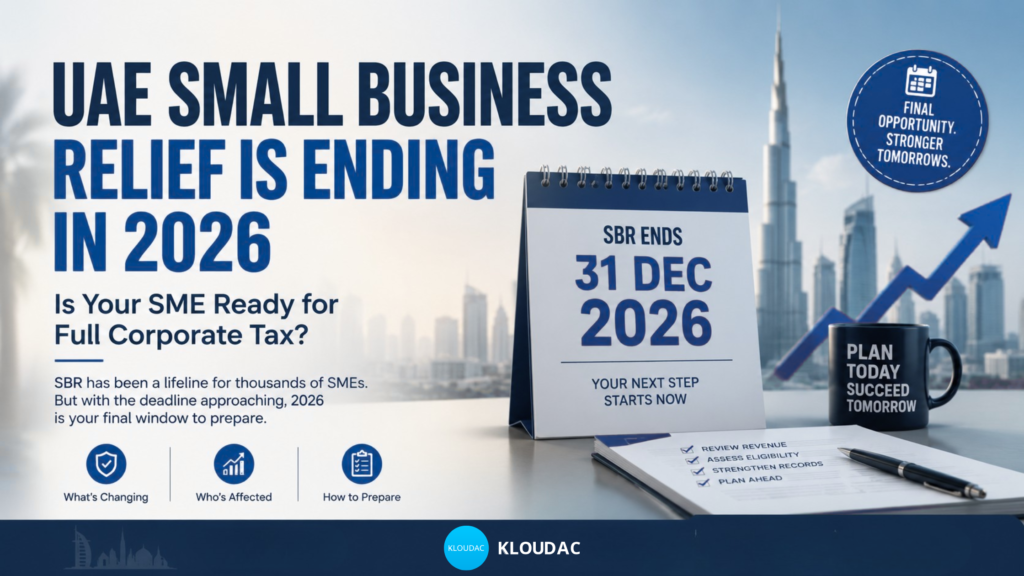
That safety net is closing. SBR is only available for tax periods ending on or before 31 December 2026. As things stand, the Ministry of Finance has not announced any extension. For every SME that has relied on this relief since UAE corporate tax began, 2026 is not business as usual; it’s the last planning window before full corporate tax UAE rules shifts to full standard rates.
This guide breaks down what’s ending, who it affects, and exactly how to prepare.
What Is Small Business Relief in UAE?
Small Business Relief is a transitional measure under the UAE Corporate Tax Law. It allows eligible resident businesses to treat their taxable income as zero for a tax period, provided their revenue stays within a set threshold.
To qualify, a business must currently meet three conditions:
- Revenue threshold: Total revenue must not exceed AED 3 million in the current tax period and every previous tax period since 1 June 2023.
- Not part of a large multinational group: The business must not belong to a Multinational Enterprise (MNE) Group with consolidated global revenue equal to or more than AED 3.15 billion.
- Not a Qualifying Free Zone Person (QFZP): A QFZP cannot elect SBR for the same Tax Period. However, a Free Zone Person that is not a QFZP may elect SBR if it meets the other conditions. A QFZP that elects to be subject to the ordinary Corporate Tax rules under Article 19 may also become eligible for SBR, subject to meeting all applicable requirements.
Importantly, SBR is not automatic. Businesses must actively elect it within the corporate tax return, filed through EmaraTax, within the standard 9 month filing deadline. Miss the election, and there’s no relief for that period, no exceptions.
It’s also worth separating two things business owners often confuse. The AED 375,000 taxable income threshold (0% tax up to this amount, 9% above it) is a permanent feature of UAE corporate tax. Small Business Relief is different, it’s a temporary election that zeroes out taxable income entirely, and it disappears after 2026.
Why the Relief Matters for SMEs
For a profitable small business, SBR has meant real money saved and real administrative simplicity:
- Zero tax liability on income that would otherwise be taxed at 9% above AED 375,000.
- Simplified compliance eligible businesses can prepare financial statements on a cash basis and avoid the full complexity of calculating taxable income.
- Breathing room for businesses that were still building out proper accounting and reporting systems when corporate tax was first introduced.
In short, SBR gave SMEs time to adjust to a completely new tax regime. It removed the full compliance burden and cash-flow hit from day one. That grace period is now on a countdown.
What Changes in 2026?
31 December 2026, this is the moment UAE corporate tax for SMEs stops being optional and starts being standard. Tax periods ending on or before that date can still elect SBR, provided the business meets the revenue and eligibility conditions. Under the current rules, Small Business Relief is available only for Tax Periods ending on or before 31 December 2026. The relevant test is the Tax Period’s end date, not its start date. For calendar-year businesses, the year ending 31 December 2026 will generally be the final eligible Tax Period. Businesses with a different Financial Year should identify their final eligible Tax Period separately.
- 0% on taxable income up to AED 375,000
- 9% on taxable income above AED 375,000
There is also a permanent consequence worth flagging: exceeding the AED 3 million revenue threshold in any prior period permanently disqualifies a business from SBR going forward, even if its revenue later drops below the cap. This makes 2026 the final opportunity for many businesses to benefit at all.
Which Businesses Will Be Affected?
The end of SBR marks a real turning point for UAE corporate tax for SMEs across every sector.
- Profitable SMEs currently under AED 3 million in revenue have been paying 0% tax. From 2027, they’ll move to 9% on income above AED 375,000.
- Businesses that have deferred proper bookkeeping: the end of SBR does not automatically require every business to move to accrual accounting or obtain audited financial statements. Businesses with Revenue not exceeding AED 3 million may continue using the cash basis of accounting for Corporate Tax purposes. Businesses exceeding that threshold will generally need accrual-based financial statements. Businesses may use IFRS for SMEs where Revenue does not exceed AED 50 million, while the Corporate Tax audit requirement generally applies to businesses with Revenue exceeding AED 50 million and to Qualifying Free Zone Persons.
- Free zone businesses weighing QFZP vs. SBR — those currently on SBR because it was simpler will need to formally assess whether assess whether the Free Zone Person meets and can continue meeting the QFZP conditions, or whether an election for ordinary Corporate Tax treatment is more appropriate.
- Businesses close to the AED 3 million threshold, since a single strong revenue year now carries a lasting effect on future eligibility.
Businesses that were never eligible for SBR (larger SMEs, MNE group members) won’t feel a direct change. But the broader compliance environment, including closer FTA scrutiny of tax paying entities, will apply to everyone.
Financial Records Businesses Should Prepare
Moving from SBR to standard corporate tax UAE compliance means financial records need to hold up to real scrutiny. SMEs should start building or tightening:
- IFRS aligned bookkeeping, replacing simplified cash basis records with accrual-based statements.
- A clear taxable income calculation trail, businesses need to properly document adjustments for exempt income, disallowed expenses, and reliefs, not just estimate them.
- Quarterly tax provisioning, so the 2027 tax bill doesn’t arrive as a surprise.
- Complete expense documentation, including invoices and supporting evidence for every deductible claim.
- Revenue history records going back to 1 June 2023, since eligibility and disqualification both depend on multi-year revenue tracking.
Common Corporate Tax Mistakes
As SMEs transition off SBR, KLOUDAC sees the same errors repeatedly:
- Assuming the Ministry of Finance will extend SBR and delaying preparation until 2027 arrives.
- Missing the active election requirement, SBR is never automatic, even for eligible businesses.
- Confusing the AED 375,000 threshold with SBR, the two are separate mechanisms with different rules and timelines.
- Under documenting expenses, which becomes far more costly once a business is actually paying 9% tax.
- Choosing QFZP vs. SBR without proper analysis, particularly for free zone businesses where the two regimes have very different long term implications.
- Late or missed filings, since the nine-month filing deadline applies regardless of whether the business owes tax.
How Do You Claim Small Business Relief, and What Happens to Losses?
The FTA does not apply Small Business Relief automatically — businesses have to claim it correctly, in the right order, every single time.
Step 1: Register for corporate tax. An eligible Taxable Person must register for Corporate Tax and obtain a TRN before electing SBR. UAE resident juridical persons generally must register, subject to the applicable exemptions and registration rules. A natural person is generally required to register only if Turnover from UAE Businesses or Business Activities exceeds AED 1 million during a Gregorian calendar year. Registration is not optional, and it has to happen before the election step.
Step 2: Elect the relief inside your tax return, for each period.Businesses must elect SBR in the Tax Return for each eligible Tax Period. Once a business submits the Tax Return without the election, it cannot subsequently claim SBR for that Tax Period.
What happens to losses and interest if you elect SBR?
This is the detail that trips up otherwise well run SMEs. In any tax period where a business elects SBR, it cannot generate new tax losses or new net interest expenditure to carry forward, because taxable income is treated as zero, there’s simply nothing for a loss to offset.
That said, losses and net interest amounts brought forward from earlier periods where the business didn’t elect SBR don’t get wiped out. They stay banked and can still be used in a future period where the business has taxable income and chooses not to elect SBR. In practice, this means a business sitting on meaningful carried-forward losses should model both scenarios before electing, sometimes forgoing SBR for a year and using the losses is the better outcome.
There’s also an anti-abuse angle worth flagging: the FTA treats splitting one business into multiple smaller entities purely to keep each one under the AED 3 million revenue cap as artificial fragmentation. The FTA can deny the relief, recover the unpaid tax, and apply penalties. If a business is genuinely approaching the threshold, the right move is proactive tax planning, not restructuring on paper.
How Professional Tax Support Helps SMEs
The shift from Small Business Relief to standard UAE corporate tax for SMEs isn’t just a rate change, it’s a shift in how a business needs to keep its books, forecast cash flow, and structure itself for the free zone vs. mainland decision.
KLOUDAC’s taxation team helps UAE SMEs navigate this transition end-to-end:
- Assessing current SBR eligibility and confirming the correct election for 2026
- Building IFRS-compliant bookkeeping systems ahead of the 2027 shift
- Calculating projected corporate tax liability under standard rates, so there are no surprises
- Advising on QFZP vs. SBR trade-offs for free zone entities
- Managing EmaraTax filings and deadlines to keep businesses fully compliant
Small Business Relief bought UAE SMEs time. What businesses do with the remainder of that time will determine how smooth, or how costly, the move to full corporate tax turns out to be.
Ready to prepare your business for the post-SBR UAE corporate tax for SMEs landscape?
Talk to KLOUDAC’s tax advisors for a personalised readiness assessment.
Frequently Asked Questions
Q : What is UAE Small Business Relief?
A : It’s an election available to eligible UAE resident taxable persons that allows them to treat their taxable income as zero for a tax period, meaning 0% corporate tax and a simplified return, provided the conditions are met. It has to be elected fresh in every eligible tax period; it isn’t a standing exemption. Understanding this election is the first step to navigating UAE corporate tax for SMEs correctly.
Q : Is the AED 3 million threshold based on revenue or profit?
A : Revenue, not profit. A highly profitable small business can still qualify for SBR as long as its total revenue stays at or under AED 3 million across the current and all prior tax periods since June 2023.
Q : Who can’t claim Small Business Relief, regardless of revenue?
A : Two groups can’t claim it outright: Qualifying Free Zone Persons (who already have their own 0% regime on qualifying income), and members of a multinational group with consolidated global revenue above AED 3.15 billion.
Q : When exactly does Small Business Relief end?
A : It’s available for tax periods ending on or before 31 December 2026. No extension has been announced as of mid 2026, so the sensible planning assumption is that 2026 is the final eligible period. From tax periods starting on or after 1 January 2027, standard rates apply, 0% up to AED 375,000, then 9% above that.
Q : Do I need to register for corporate tax even if I plan to claim SBR?
A : Yes. A Taxable Person wishing to elect SBR must first register for Corporate Tax. However, whether a person is required to register must be determined under the applicable registration rules, including the AED 1 million Turnover threshold for natural persons.